
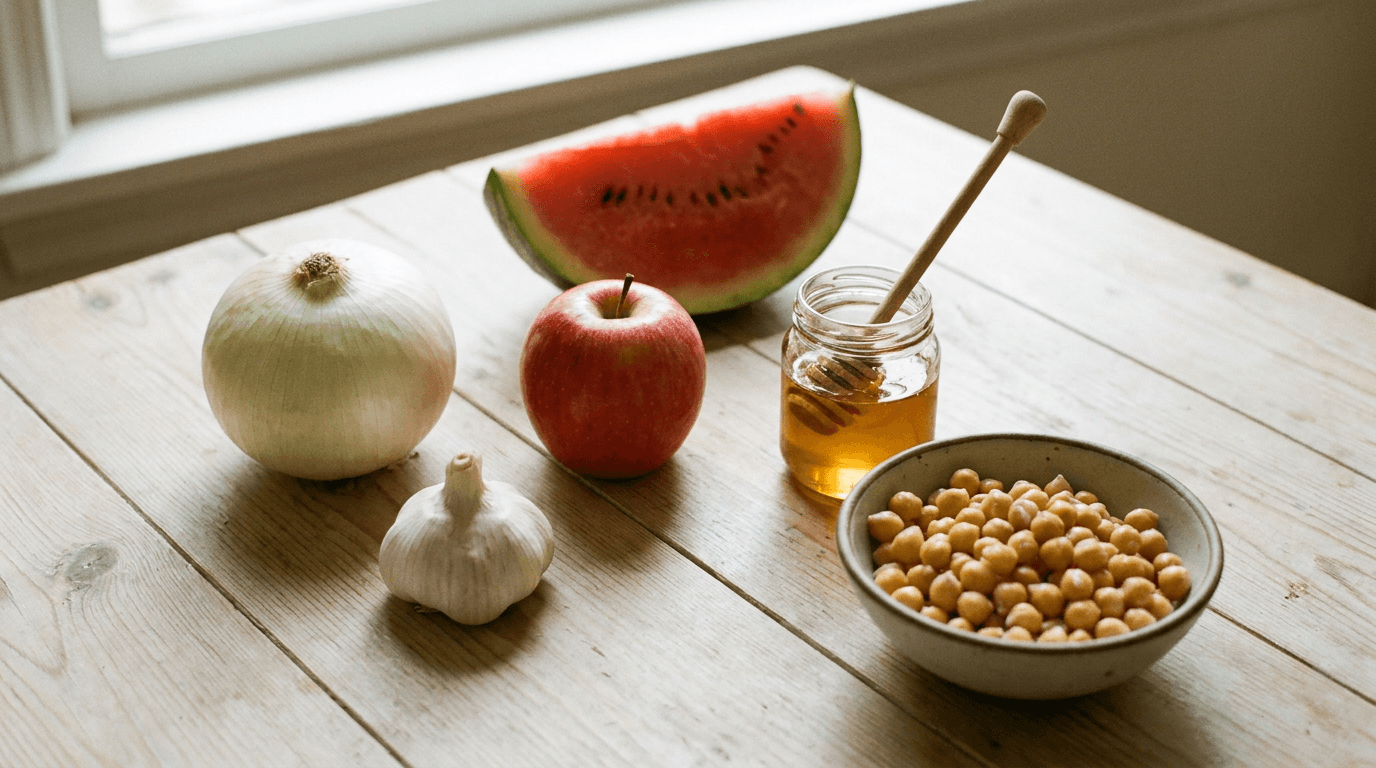
If you have IBS, you have probably noticed that certain meals set off bloating, cramps, or an urgent dash to the bathroom while others leave you fine. The usual suspects are not random. Most of the classic offenders share a chemistry problem: they are rich in FODMAPs, a group of fermentable carbohydrates that draw water into the gut and feed the bacteria that produce gas. This guide walks through the ten worst foods for IBS, explains the specific FODMAP behind each one, and shows you why "worst" is really about you and how much you eat.
A quick reminder before the list: FODMAP stands for Fermentable Oligosaccharides, Disaccharides, Monosaccharides, And Polyols. These are short-chain carbs your small intestine struggles to absorb. In a sensitive gut, that means fermentation, gas, and stretching of the bowel wall, which registers as pain. If any of this is new, start with our low-FODMAP diet guide for the full picture.
Why "worst foods" is the wrong way to think about IBS
There is no universal blacklist. IBS triggers are individual, and the single most important variable is dose. A food that wrecks your afternoon in a large portion may be completely comfortable in a small one, because FODMAPs stack up in your gut until they cross your personal threshold. That is exactly why the low-FODMAP protocol has three phases: you eliminate to calm things down, reintroduce to test each FODMAP group, and then personalise so you eat the widest diet your gut can handle. The list below tells you what tends to cause trouble and why, not what you must avoid forever.
The ten worst foods for IBS (and the FODMAP behind each)
1. Onion — fructans
Onion is arguably the most common hidden trigger there is. It is loaded with fructans, a type of oligosaccharide that no human gut can fully digest. Because onion appears in stocks, sauces, and seasoning blends, people often react without realising it is even in their food. Frustratingly, fructans are water-soluble, so cooking or frying does not remove them.
2. Garlic — fructans
Garlic is onion's partner in crime and, gram for gram, even more concentrated in fructans. Even garlic powder and garlic-infused products can carry enough to bother a sensitive gut. The good news: fructans do not dissolve in oil, so garlic-infused olive oil gives you the flavor without the FODMAP load once you reach the personalise phase.
3. Wheat bread — fructans
Wheat is not a problem because of gluten for most people with IBS; it is the fructans. Regular wheat bread delivers a meaningful dose, especially in larger portions, which is why so many people feel bloated after sandwiches or pasta. Note that this is about quantity, not total avoidance. Slower-fermented options like spelt sourdough are often far gentler because the long proving time breaks down much of the fructan content.
4. Milk — lactose
Cow's milk is the classic disaccharide trigger. If you are low on the lactase enzyme, undigested lactose ferments and pulls water into the bowel, causing gas and loose stools. This one has an easy swap: lactose-free milk contains the same protein and nutrition with the lactose already broken down, so it usually causes no symptoms at all.
5. Apples — excess fructose and sorbitol
An apple is a double hit. It contains more fructose than glucose (excess fructose is the "monosaccharide" M in FODMAP) plus sorbitol, a polyol. Pears share the same problem. Because two FODMAP types are present, apples reach many people's threshold quickly, which is why "an apple a day" is often the opposite of helpful for IBS.
6. Legumes — galacto-oligosaccharides (GOS)
Beans have a reputation for a reason. Baked beans, kidney beans, and chickpeas are rich in GOS, oligosaccharides we lack the enzyme to break down. Canning and rinsing helps because some GOS leaches into the liquid, so a small portion of well-drained canned legumes is often tolerable even when a big bowl of home-cooked beans is not.
7. Honey — excess fructose
Honey is close to pure trouble for fructose malabsorbers because it contains far more fructose than glucose. Agave syrup is similar. When there is not enough glucose to help ferry the fructose across the gut wall, the excess ferments. Maple syrup or plain table sugar are usually easier sweeteners, since sucrose is balanced.
8. Cauliflower — mannitol
Cauliflower is high in mannitol, a polyol that is poorly absorbed and osmotically active, meaning it drags water into the gut. Mushrooms are another mannitol-heavy culprit. Cruciferous vegetables get blamed broadly, but not all deserve it: broccoli tops in smaller servings, so the specific vegetable and portion matter a lot.
9. Sugar-free sweeteners — sorbitol and xylitol
The polyols hiding in "sugar-free" gum, mints, and diet products are a sneaky trigger. Sorbitol and xylitol are added precisely because they are poorly absorbed, which is also why they cause gas and diarrhea. If you chew sugar-free gum through the day, that alone can be enough to keep symptoms going.
10. Watermelon — the triple threat
Watermelon is unusual because it carries excess fructose, fructans, and polyols all at once. That stacking makes it one of the most reliable fruit triggers, even in modest amounts. Lower-FODMAP fruits like strawberries, blueberries, or a small serving of grapes are gentler ways to satisfy a fruit craving.
Dose and stacking: the part most lists skip
Here is the nuance that makes or breaks the low-FODMAP approach. FODMAPs are additive. A small serving of several moderate foods across one meal can push you over your threshold just as easily as one high-FODMAP food. That is why a "safe" breakfast plus a "safe" snack can still add up to a bad afternoon. Managing IBS is less about permanent bans and more about spacing, portioning, and knowing your own limits.
What to do with this list
Do not treat these ten foods as forbidden. Treat them as the first places to look when you are troubleshooting a flare. During a structured elimination phase you would cut the high-FODMAP items back, let your gut settle, and then methodically reintroduce each FODMAP group to find your actual triggers. Many people discover they tolerate lactose fine but react hard to fructans, or vice versa. That personal map is the whole point.
To check where a specific food stands, browse the food database, where every entry shows its FODMAP profile and the research behind its serving thresholds. IBS is a condition you manage rather than cure, and getting the diagnosis and support of a doctor or registered dietitian makes the process far safer and more effective, especially before cutting out food groups long term.
Ready to stop guessing? Phase checks any food's serving size against published thresholds, logs your meals, and helps you pinpoint your personal triggers through the full three-phase protocol. Download Phase and start building the widest, most comfortable diet your gut can handle.